
UN teams in Gaza continued to collect food and fuel from the Kerem Shalom crossing over the weekend, UN Spokesperson Stéphane Dujarric told journalists in New York.
He explained, however, that what humanitarians and the private sector can bring in is limited because all other crossings remain closed for cargo while restrictions on specific types of supplies remain in place.
Drop in aid volume
“Data from the UN 2720 Mechanism shows a decline in the overall volume of supplies that we and our partners have been able to bring in last month, less than 42,000 pallets, down from about 46,600 in May,” he said.
The Mechanism, authorised under Security Council Resolution 2720 (2023), aims to accelerate aid flows into the enclave. Humanitarian organizations register planned aid consignments on a portal and database where they are tracked.
The initiative supports the movement of the consignments, including through the Jordan Corridor route and by sea via the Ashdod port in Israel.
Mr. Dujarric said that last week, only 42 per cent of the supplies from Egypt and 65 per cent of those from Ashdod port could be offloaded at the Kerem Shalom crossing, even though they were “already approved in principle”.
Surviving childhood
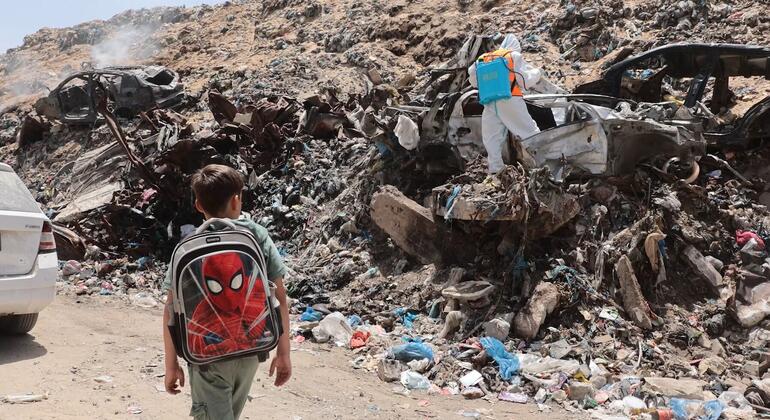
The UN continues to voice concern for children across the Occupied Palestinian Territory (OPT).
Child rights agency UNICEF underscored the need for youngsters in Gaza to receive proper nutrition, healthcare and protection, after more than 1,000 days of war.
Children “have been killed, maimed, displaced, and deprived of the essentials that they need to survive, grow, and recover,” Spokesperson Louise Wateridge told UN News on Monday.
She said reports indicate that overall, more than 60,000 children have been killed or injured, while “a child has been killed on average every single day for more than eight months” despite the October ceasefire.
“Children in Gaza have taken their first steps through rubble, spoken their first words against the deafening sounds of bombs and strikes, and they’ve known nothing but war, displacement, and loss. Others didn’t even survive long enough to speak their first words,” she said.
“Childhood should not begin in survival mode. No child’s earliest years should be defined by the sounds of bombs and strikes, the loss of home, or the absence of enough food, water, and care.”
Young lives lost in the West Bank
Meanwhile, the UN aid coordination office OCHA said that Israeli forces shot and killed a 16-year-old in the West Bank on Sunday.
The incident occurred at the Qalandiya camp, near Jerusalem. Two other children were shot in the lower limbs.
“This is another reminder that Palestinians in the West Bank must be protected, as required by law, and that perpetrators of violations must be held accountable,” OCHA said.
The UN human rights office, OHCHR, also reported on the death of a critically ill infant in Ramallah governorate on Sunday.
The four-month-old boy died after Israeli forces refused to open a gate blocking the main entrance to his village, thus delaying his access to medical care while an ambulance was waiting on the other side.
Writing on social media, OHCHR recalled that last month, a seven-month-old boy was shot and killed by an Israeli soldier at a checkpoint.
“Both deaths are senseless, and both are emblematic of an occupying power continuing to show utter disregard for the humanity and rights of Palestinians living under occupation,” said Ajith Sunghay, Head of UN human rights in the OPT.