

Welcome back to World Brief, where we’re looking at protests in Ukraine, Iran’s new threats to the Gulf region, and dangerous air quality levels for Canada and the United States.
Goodbye, Fedorov
Thousands of people took to the streets on Thursday to protest Ukrainian President Volodymyr Zelensky’s cabinet reshuffle. Although several notable officials were replaced or reassigned, including Prime Minister Yulia Svyrydenko, public outcry primarily centered on the ouster of one individual: Defense Minister Mykhailo Fedorov.
Welcome back to World Brief, where we’re looking at protests in Ukraine, Iran’s new threats to the Gulf region, and dangerous air quality levels for Canada and the United States.
Goodbye, Fedorov
Thousands of people took to the streets on Thursday to protest Ukrainian President Volodymyr Zelensky’s cabinet reshuffle. Although several notable officials were replaced or reassigned, including Prime Minister Yulia Svyrydenko, public outcry primarily centered on the ouster of one individual: Defense Minister Mykhailo Fedorov.
At just 35 years old, Fedorov has garnered the reputation of a modernizer. Having spearheaded Kyiv’s technology drive, including its drone development program, Fedorov is seen by many as key to Ukraine’s recent battlefield successes. Mid- and long-range drone attacks have proved to be particularly effective at disrupting Russian supply lines and straining Moscow’s wartime economy.
During his six months in office, Fedorov also redirected funds earmarked for salaries into military investments, persuaded Starlink CEO Elon Musk to cut off the Kremlin’s access to its satellite communications system, and pushed for greater transparency in weapons procurement deals—all accomplishments Fedorov himself detailed in a social media post following his firing. Many Ukrainians have praised Fedorov for cracking down on corruption and pushing for asymmetric warfare that would limit Ukrainian casualties.
On Thursday, protesters in Kyiv and other cities across the country held up signs that read “Hands off Fedorov” and “Stop sabotaging victory!” while chanting “Shame!”
Yet Fedorov was not without enemies. The Financial Times reported on Wednesday that Fedorov had angered powerful people in the country’s political and defense circles by refusing to give lucrative procurement contracts to their preferred companies. However, Zelensky on Thursday cited a growing rift between Fedorov and Gen. Oleksandr Syrskyi, the commander of Ukraine’s armed forces, as the reason for his dismissal.
“I’m just showing that if the sides can’t resolve an issue, I will have to resolve it,” Zelensky told reporters.
Fedorov appeared to confirm that rationale, accusing Syrskyi of blocking all of his recent initiatives, including needed drone reforms. “The war has changed completely,” Fedorov said on Thursday, arguing that new advancements are necessary to counter Russia. “Under this arrangement [with Syrskyi as commander], I personally do not know how the war can be won.”
Zelensky appointed Maj. Gen. Yevhen Khmara, the acting head of Ukraine’s Security Service, to serve as interim defense minister. But several high-ranking officers remain unappeased. “I believe that the dismissal of Mykhailo Fedorov is a great evil for the country’s defense capability,” Col. Pavlo Yelizarov, the deputy commander of Ukraine’s air force, wrote in a resignation letter on Thursday. Yelizarov warned that Fedorov’s dismissal would weaken Kyiv’s air defenses and lead to more fatalities.
This was Zelensky’s second cabinet reshuffle in a year. But more notably, Thursday was the second time that Ukraine has faced mass anti-government protests since Russia launched its full-scale invasion in February 2022.
Despite the controversy over Fedorov’s dismissal, parliamentarians overwhelmingly approved Sergii Koretskyi to be Ukraine’s new prime minister. Koretskyi previously served as head of Ukraine’s state energy company, Naftogaz. Zelensky has argued that this experience makes him best equipped to counter Russian attacks on the country’s power grid.
Today’s Most Read
What We’re Following
Threats to energy. Iran warned on Thursday that “all infrastructure in the region will be crushed” if the United States attacks the country’s civilian infrastructure, as U.S. President Donald Trump has previously threatened to do.
Tehran has also reportedly instructed the Houthis in Yemen to shut the Bab el-Mandeb if Trump follows through on his threat to attack Iran’s power plants and bridges. Sources told Reuters on Thursday that the Iranian proxy group has already completed preparations necessary to be able to attack shipping near the Red Sea gateway. Doing so would further exacerbate the global energy crisis caused by Iran effectively closing the Strait of Hormuz.
Trump has not yet ordered attacks on civilian infrastructure, but the bombing campaign against Iranian military targets continues. Strikes intensified for a fifth consecutive day on Thursday, with the U.S. military hitting targets farther north as well as firing at a ship that was reportedly trying to break the U.S. naval blockade. Just hours earlier, U.S. Central Command said troops had hit Iranian command and control centers, air defense sites, missile and drone facilities, and coastal surveillance locations.
Hazardous air quality. Forest fires in northwestern Ontario blanketed Canada’s Greater Toronto Area in heavy smoke on Thursday. With air quality at dangerous levels and visibility reduced for much of the region, Ottawa warned locals—regardless of age or health—to remain indoors or wear “well-fitted and properly worn” masks to reduce exposure. Toronto ranked second Thursday morning for the world’s most polluted city, according to Swiss monitor IQAir.
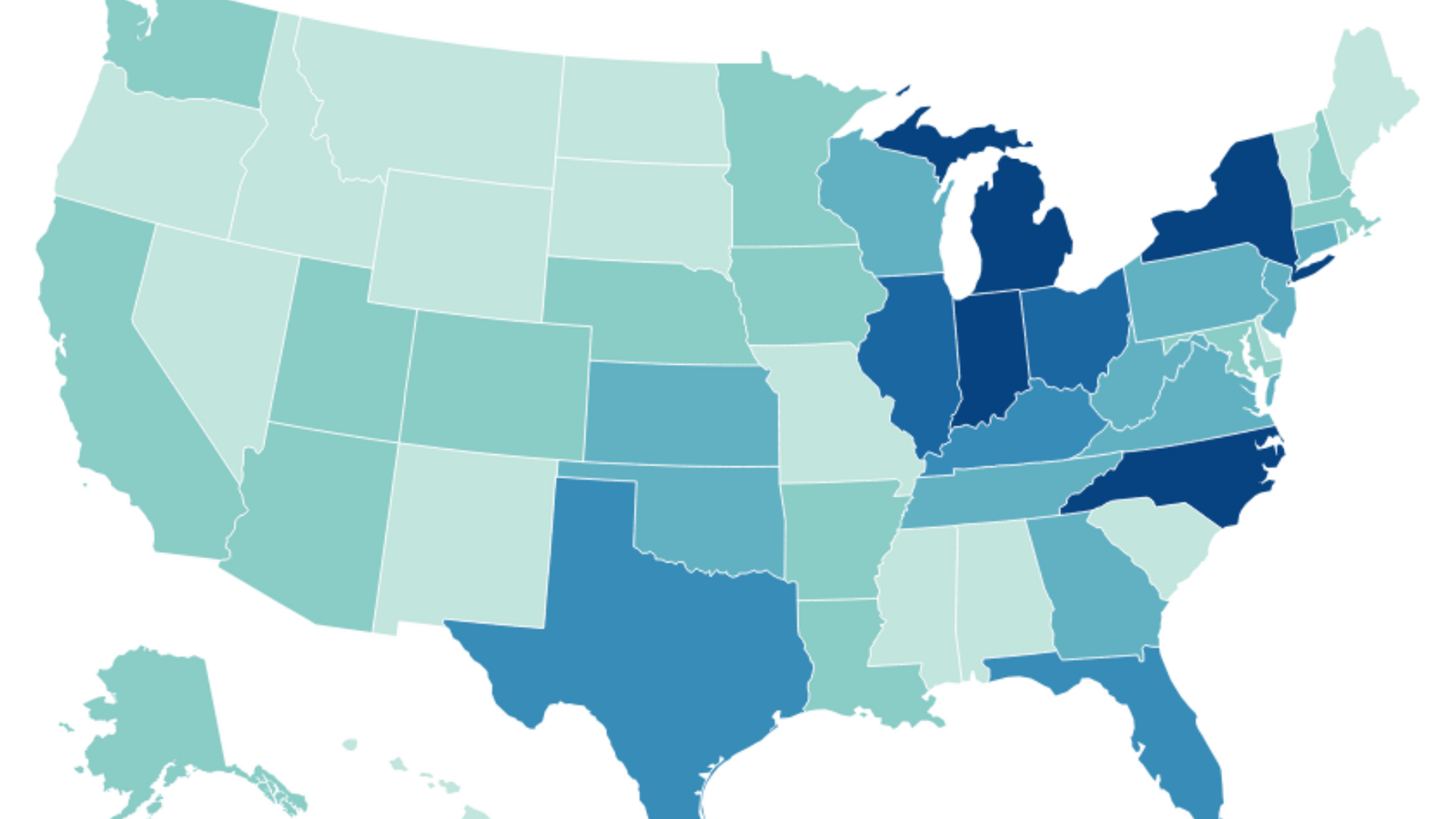
Dense smoke from the fires also darkened skies across several U.S. regions on Thursday, including the Upper Midwest, the Great Lakes, and New England. According to the same Swiss report, the U.S. city of Detroit was the most polluted city in the world early Thursday, with the air quality index hitting “hazardous” levels. Minneapolis and Chicago, also located near the Canadian border, hit the third and fourth spots, respectively. Meteorologists warned on Thursday that the smoke could reach as far south as Maryland.
Worsening climate change in recent years has raised temperatures and reduced rainfall, creating the ideal conditions for wildfires. Experts have found that the number of days when it is both hot and polluted has also increased. More than 115 million people are forecasted to be exposed to air quality levels that are unhealthy or worse through the end of this week.
New levies. The United States unveiled a 25 percent tariff on many Brazilian imports late Wednesday, reigniting a trade war between Washington and Latin America’s largest economy. Although several major Brazilian products—such as aircraft parts, beef, and rare earths—will be exempt from the new duties, the late-night announcement is expected to stir up concerns that the Trump administration is renewing its global trade war.
In February, the U.S. Supreme Court ruled that the White House did not have the authority to impose sweeping tariffs under the 1977 International Emergency Economic Powers Act. The decision marked a big win for countries such as Brazil, which faced one of the highest U.S. tariff rates in the world. But Trump vowed to impose new tariffs under different authorities—specifically, Sections 122 and 301 of the 1974 Trade Act; Wednesday’s announcement relies on Section 301 for justification.
Over the past few months, U.S. and Brazilian officials have tried to negotiate a favorable trade deal—without success. “For the past year, [Brazilian President Luiz Inácio Lula da Silva] has put his own ego ahead of making a deal for the welfare of the Brazilian people, and these tariffs are the price for that,” U.S. Secretary of State Marco Rubio wrote on X on Wednesday.
Lula immediately denounced the new tariffs and vowed to bring the matter to the World Trade Organization. The new duties are expected to take effect on July 22.
Odds and Ends
Say hello to Likweli (or what zoologists call Colobus congoensis), a new species of monkey identified in the Democratic Republic of the Congo. Researchers stated on Wednesday, following the release of a study in PLOS One, that the small, orange-lipped primate has “distinctive cranial, dental, and skeletal characteristics that separate it from every other known African colobus monkey.” It is the fifth new monkey species to be identified in Africa in the past 75 years.