
After decades of being closed to the public, the bank that Hamilton built reopens in Philadelphia’s Old City this Wednesday.
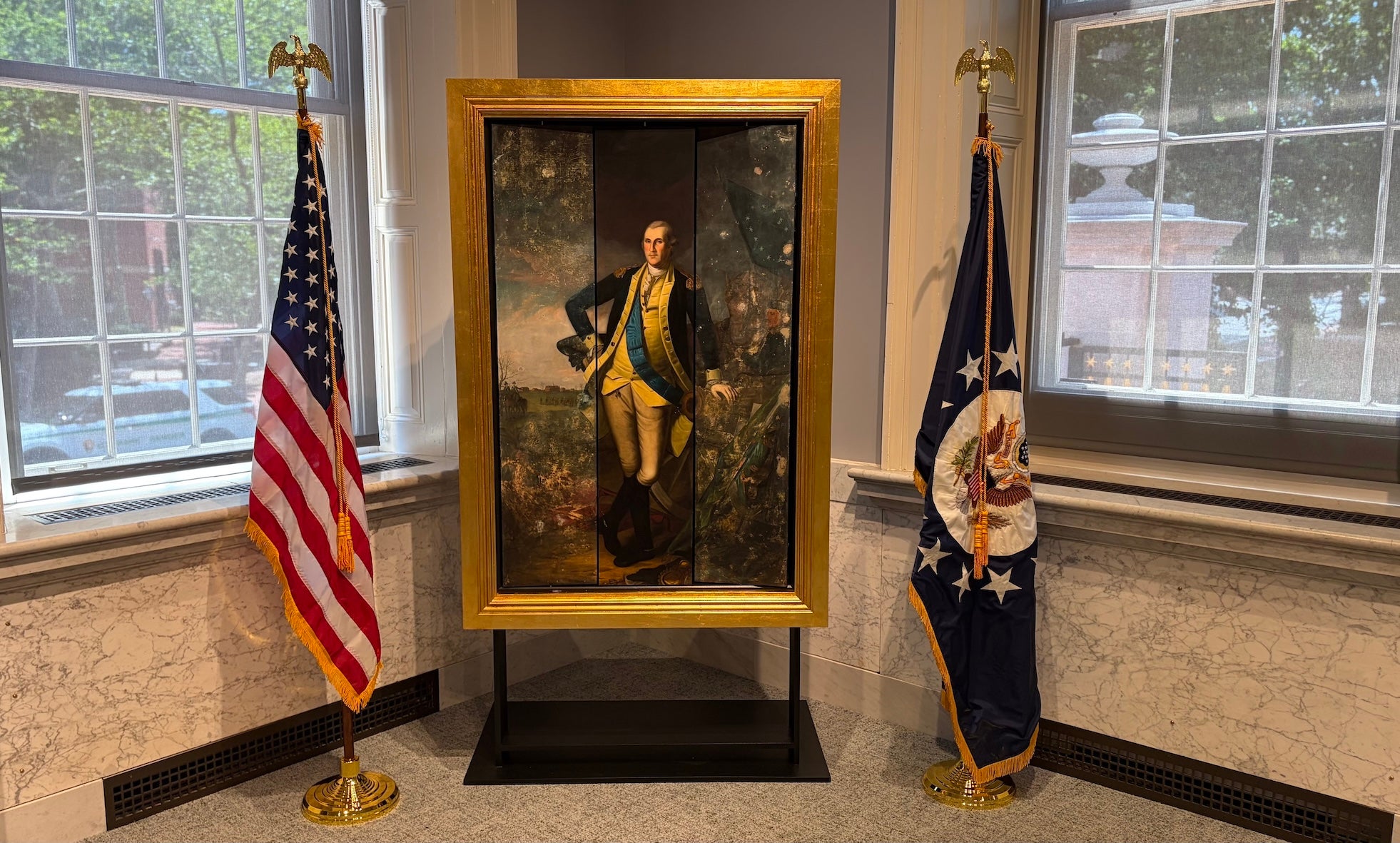
After $43 million of renovations by the National Park Service, the First Bank of the United States building at 3rd Street near Chestnut is once again a public amenity, with an exhibition by the U.S. Department of State featuring precious diplomatic gifts that have never been publicly displayed before.
The classical building, wrapped in marble with towering columns and grand steps, was built in 1797 as the flagship of the First National Bank, Alexander Hamilton’s bold and controversial idea to create a federal banking system. Some of the founding fathers, most prominently Thomas Jefferson, were fundamentally opposed to the new government centralizing banking and currency.
Independence National Historic Park ranger Bill Caughlan said Hamilton needed to sell the concept of national financial stability by creating monumental buildings.
“The building itself is designed to convey confidence, strength, stability for a bank at a time when not everyone thought well of banks,” Caughlan said. “You want to have something that looks impressive and would instill confidence in people.”
Several branches of the First National Bank were built in coastal cities with a lot of trade. One of the chief functions of the bank was to collect tariffs from merchants importing goods from overseas.
“A lot of times these merchants weren’t able to afford to pay the tariff, they haven’t sold their goods yet, so they could take a loan out from the bank at a percentage, maybe for 60 days, deal with what they had to do with their goods and then repay the loan,” Caughlin said. “That part of it worked pretty well.”
One of the surviving First Bank buildings is in Charleston, South Carolina, where it is now used as City Hall.
Artifacts from the 1976 Bicentennial celebration in Philadelphia are on display in a temporary exhibition at the First Bank of the United States building. (Peter Crimmins/WHYY)
A brief history of the First Bank of the United States building
The Philadelphia building outlasted the institution for which it was built. The U.S. Congress chartered Hamilton’s idea for 20 years, from 1791 to 1811, when it did not renew the charter. The building was then bought by Stephen Girard, then the wealthiest man in America, for use as a private bank. After Girard’s death in 1831, the building was sold to another private bank that named itself after Girard.
In the 20th century, the building was acquired by the National Park Service, which then used it for storage.
“The architectural collection was stored here,” Caughlan said. “In the basement, we kept our brochures.”
Although the public was not allowed inside the building, interest never faded. The front steps are popular with wedding photographers, and following the success of the musical “Hamilton,” people come just to see his legacy.
“There was a random day in the last 10 years, I couldn’t tell you the exact year … the building was open to the public for one day,” said park ranger Michael Carbonaro. “In that day, about 3,000 people came through.”
In 2023, the Independence Historic Trust announced plans to restore and renovate the building, with preliminary ideas to transform it into a museum of the American economy. Since then, the concept has narrowed to the building’s history.
“We’re trying to focus on what this building represents because it is an actual artifact itself,” said Rosalind Remer, director of Drexel University’s Lenfest Center for Cultural Partnerships. “It is an artifact that allows us to tell the story of Hamilton, the founding of the bank, why he did it, what happened to it after 20 years, and why there’s a Second Bank around the corner.”
Such an exhibition will likely be ready in 2028. Until then, the building will be open with temporary exhibitions.