
‘I am the American story’
At 1 p.m., the Avenging the Ancestors Coalition, or ATAC — the group that was formed to advocate for the original slavery exhibit — staged a performance with actors telling the stories of the nine people enslaved by Washington. The youngest, Khylei Bailey, 8, recounted the life of Richmond, the 11-year-old son of Washington’s cook Hercules Posey and seamstress Alice.
“I also have to sweep the chimneys, which is very dirty work,” he said. “I once tried to escape from George Washington but did not make it. I’m just happy that my father will eventually escape to freedom. I am the American story.”
ATAC activist Farugh Maat said it was important for them to “tell the whole story” of American history.
“George Washington was a magnificent general, great president, but you can’t be a great human being if you’re enslaving people,” he said. “When you talk about white liberty, you got to talk about African bondage. That’s part of the story. Everything has a contrast. And so that’s why we here. We got to tell our ancestors’ story.”
Among the several dozen attendees were City Councilmember Rue Landau, Philadelphia District Attorney Larry Krasner and City Council President Kenyatta Johnson, who also took to the podium to speak.
“I think about my two boys, Isaiah Mandela and Elijah Kwame, growing up here — not only here in the city of Philadelphia, but most importantly in this country — and I’m always advocating on the front line to make sure that they deserve to have a city and a country that advocates for freedom, justice and equality for everyone,” he said. “So as we celebrate this Fourth of July, let’s continue to make sure we are advocating and fighting for progress and justice for everyone.”
The fight continues
The legal battle over the site started when President Donald Trump issued an executive order, “Restoring Truth and Sanity to American History,” which directed federal agencies to remove or revise content deemed “improperly disparaging” to American history. The National Park Service subsequently moved to alter the President’s House exhibit, prompting the city of Philadelphia to sue in January. A federal district judge ordered them restored.
However, the Trump administration appealed to the 3rd Circuit, which reversed the lower court’s decision. On Friday, the appeals court cleared the way for the park service to erect the new proposed exhibit “without further delay.” The Parker administration then immediately sought further review of the ruling.
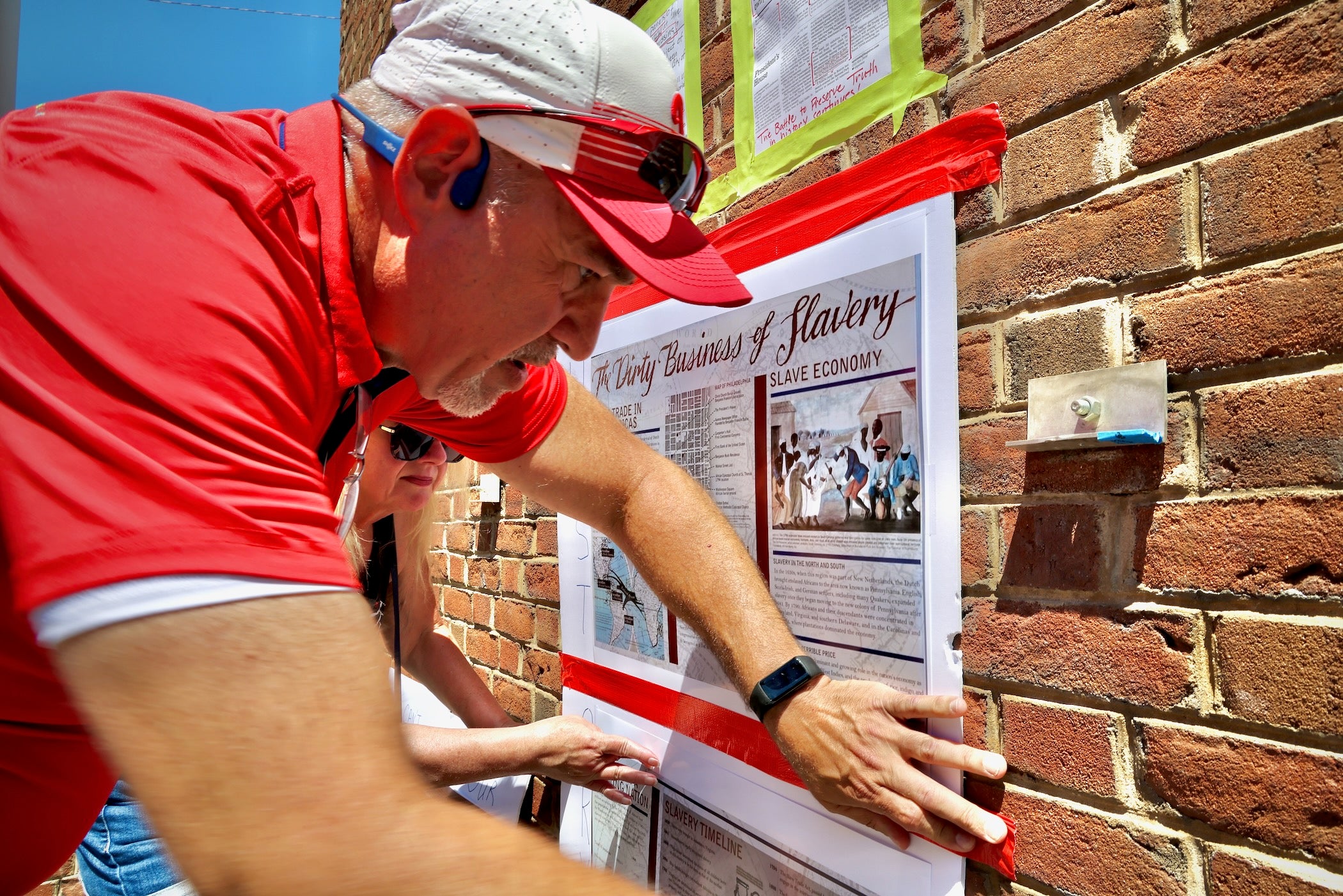
The new panels also mention the nine people enslaved at the site. However, they change the overall tone of the exhibit, softening and significantly reducing references to slavery, and shifting the focus toward the “anti-slavery sentiments” of the slave-owning Founding Fathers.
The new exhibit also goes deeper into the house’s history and gives more space to Washington’s actions, while living in the house, that are not related to slavery.
Timothy Welbeck, a professor and director of the Center for Anti-Racism at Temple University who was also visiting the site, said that those stories are prevalent enough around Philadelphia.
“We know that part of the story,” he said. “What most of the people who come through here do not know is the story of Ona Judge and Paris and Christopher and the others who were enslaved here. And so to de-emphasize them, particularly when they have such a foundational role in the creation of America, is not something that should be happening.”
Timothy Welbeck, director of the Center for Anti-Racism at Temple University, visits the President’s House Site at Independence National Historical Park. (Emma Lee/WHYY)
The fight to protect the exhibit drew support from across the political spectrum, from Gov. Josh Shapiro to Pennsylvania’s Republican U.S. Sen. David McCormick.
Michael Coard, an attorney and co-founder of ATAC, told the audience Saturday that they intend to continue to fight, either by seeking an en banc review — whereby all active judges of an appellate court hear a case together, rather than the usual three-judge panel — or possibly filing another “more expansive” lawsuit. He said an appeal to the U.S. Supreme Court was unlikely.
“Sometimes you’ve got great legal issues, but you don’t take them to a court that’s going to rule against you,” he said.
Michael Coard, founder of the Avenging the Ancestors Coalition, talks with reporters at the President’s House Site at Independence National Historical Park. Coard and his organization have been fighting the Trump administration’s efforts to make changes to the site, which memorializes the nine people enslaved by George Washington during his presidency in Philadelphia. (Emma Lee/WHYY)