
From Philly and the Pa. suburbs to South Jersey and Delaware, what would you like WHYY News to cover? Let us know!
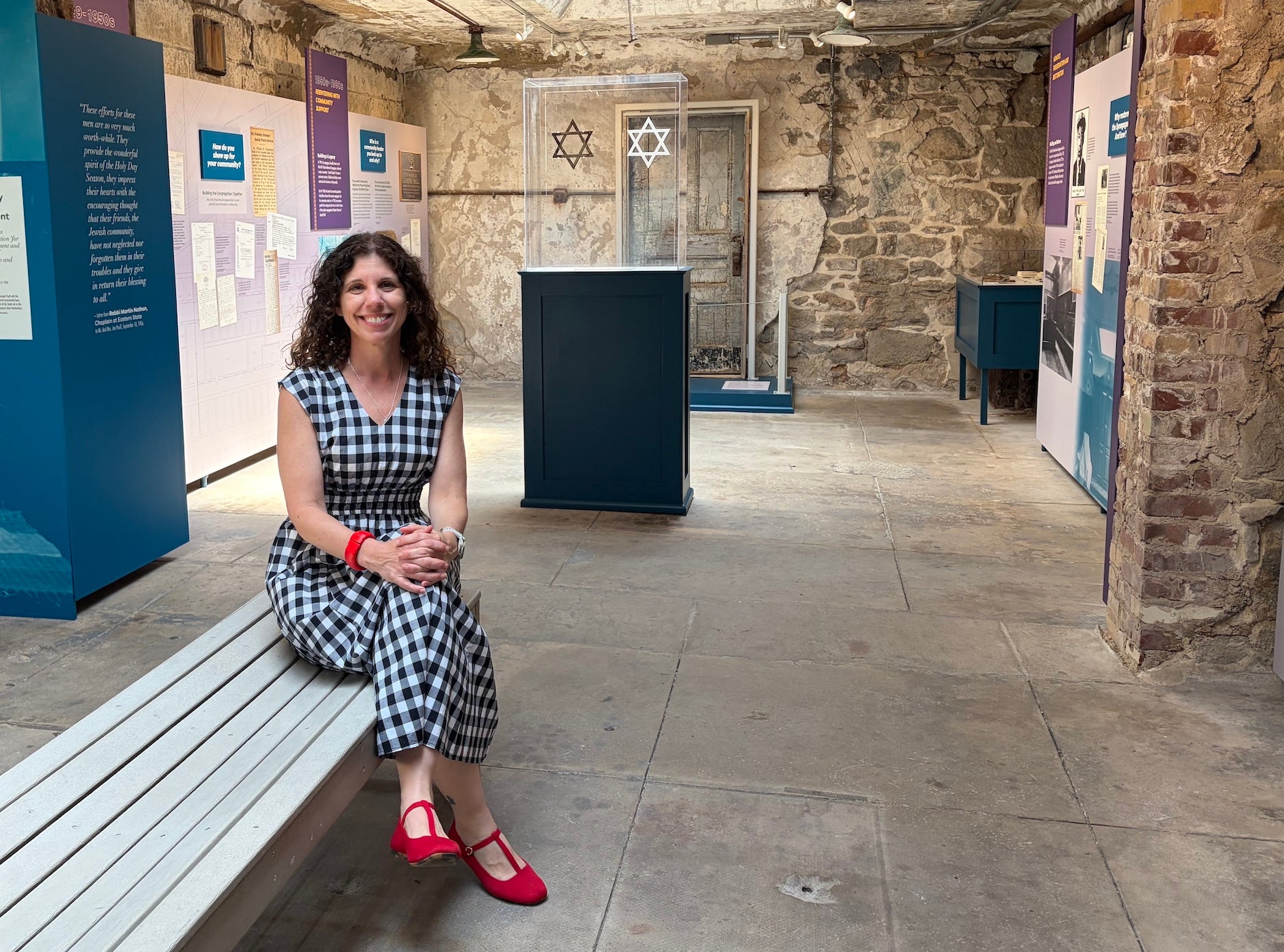
The Eastern State Penitentiary in Philadelphia is using its restored prisoner’s synagogue to show how engaging in religious practices while incarcerated has never been simple or straightforward.
The historic stone prison, now a museum and visitor attraction, was the first to establish a dedicated synagogue in 1922. The overall design concept for Eastern State was influenced by religious ideas of penitence, its isolating cells intended to push inmates into contemplating their past criminal acts in a spiritual light.
Josh Perelman, consulting curator for “Freedom Through Faith: Judaism at Eastern State and Beyond,” said the religious underpinnings at the penitentiary were Christian.
“Historically, prisons have always been faith communities,” he said. “What this synagogue does is become a real-life testament to what is a growing legal expansion of the rights of inmates to religion of their own.”
Rocky legal road for religious practice in prison
Although the First Amendment guarantees religious freedom in America, when a person is incarcerated, those freedoms become murky, at best, and often disappear. The exhibition describes an 1871 U.S. Supreme Court decision that all personal rights are forfeited when a person becomes a prisoner, “a slave of the state,” reads the Ruffin v. Virginia decision. By the mid-20th century, courts allowed certain rights to be retained.
A legal timeline on display in Eastern State Penitentiary’s ‘Freedom Through Faith’ exhibition, show how U.S. Supreme court has fluctuated on prisoner’s religious liberties. (Peter Crimmins/WHYY)
Since then, courts have gone back and forth over how much religious liberty can be extended to prisoners. For example, judges have ruled that inmates can have religious texts, such as a Quran, in their cell, but also that prisons can restrict inmates from congregating for Muslim prayers.
The uncertainty of practicing religion in prison is ongoing. In 2022, the Supreme Court ruled that inmates sentenced to death have a right to a spiritual leader with them at the moment of execution, but to this day some states do not comply.
Days before “Freedom Through Faith” opened at Eastern State, the Supreme Court made a mixed ruling on a case involving a Rastafarian inmate whose dreadlocks — a recognized part of that religious practice — were forcibly cut off by guards. The court ruled the plaintiff had a right to dreadlocks but did not have the right to sue the individuals who cut them all.
Perelman said the creation of a dedicated space for Jews inside a prison in 1922 was remarkable, given the national mood at that time.
“It was a very complex time in our nation’s history: The height of the eugenics movement, the height of an anti-immigrant movement, legislation against immigrants,” he said. “Here in Philadelphia, a community came together, an interfaith community, to create a sacred space for Jews imprisoned in Eastern State.”
Perelman added that as the United States celebrating its 250th anniversary, the space shows that “no matter what is happening in the larger context of our nation, local communities have real power.”