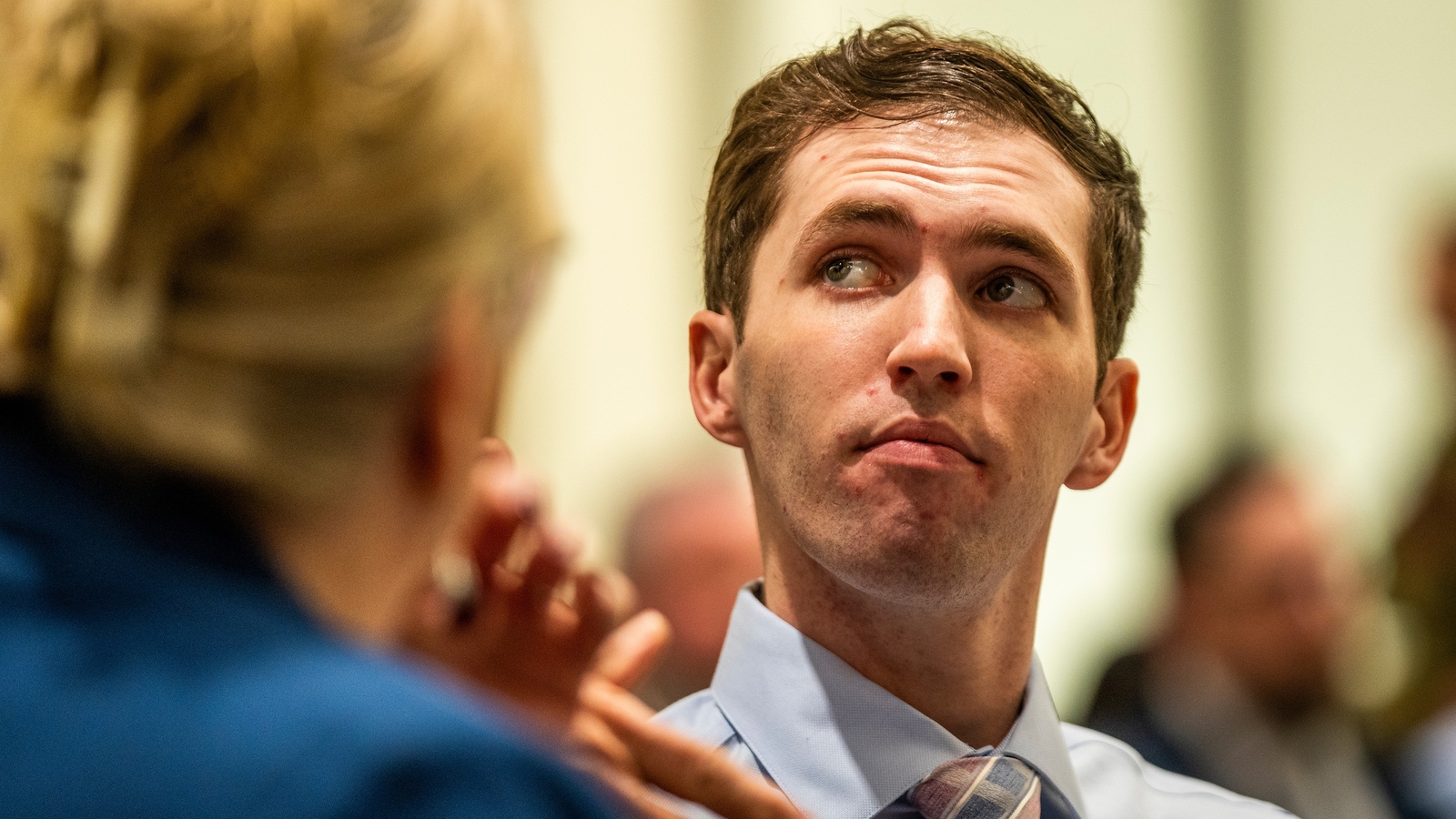


Serhii, a 46-year-old Ukrainian army officer who ran a furniture store in civilian life, has survived four years of war against Russia. These days, he commands a battalion of 300 troops in Ukraine’s front-line city of Sloviansk. After two combat injuries and the loss of many friends, his take on the war is anchored in harsh experience.
So it is all the more striking to hear his assessment of where things stand. “We’ve reached a turning point,” he told me during my visit to Sloviansk in late June. The Ukrainians, he said, are striking devastating blows against Russia’s energy infrastructure, vital logistics, and the factories that produce critical components for its high-tech weaponry. He particularly applauded Kyiv’s campaign to sever the supply lines that provide Russian forces in occupied Crimea with ammunition, fuel, and food. So how long will it take to cut off the peninsula entirely? “I think we can do it by the end of the summer,” he answered, noting that this would be a huge humiliation for Russian President Vladimir Putin, who has cited Russia’s 2014 seizure of the Ukrainian peninsula as one of his lasting achievements.
Serhii, a 46-year-old Ukrainian army officer who ran a furniture store in civilian life, has survived four years of war against Russia. These days, he commands a battalion of 300 troops in Ukraine’s front-line city of Sloviansk. After two combat injuries and the loss of many friends, his take on the war is anchored in harsh experience.
So it is all the more striking to hear his assessment of where things stand. “We’ve reached a turning point,” he told me during my visit to Sloviansk in late June. The Ukrainians, he said, are striking devastating blows against Russia’s energy infrastructure, vital logistics, and the factories that produce critical components for its high-tech weaponry. He particularly applauded Kyiv’s campaign to sever the supply lines that provide Russian forces in occupied Crimea with ammunition, fuel, and food. So how long will it take to cut off the peninsula entirely? “I think we can do it by the end of the summer,” he answered, noting that this would be a huge humiliation for Russian President Vladimir Putin, who has cited Russia’s 2014 seizure of the Ukrainian peninsula as one of his lasting achievements.
One year ago, it would have been hard to classify Serhii’s view of the war as anything other than wishful thinking. Back then, despite a few remarkable successes, Kyiv’s overall war effort seemed scattershot and unfocused. Yet over the past few months, the world has witnessed a dramatic transformation in Kyiv’s ability to take the fight to the Russians.
One development stands out: For the first time since Moscow’s full-scale invasion in 2022, Ukraine’s military leaders have worked out a coherent strategy for victory—a plan designed to play to Kyiv’s strengths and exploit Russian weaknesses. Mykhailo Gonchar, the president of the Strategy XXI Center for Global Studies in Kyiv, told me that the Ukrainian leadership now believes that it can “cut off a significant share of the revenues financing the [Russian] war budget, trigger a fuel crisis, and surgically sever the critical links in the defense-industrial supply chain, thereby reducing—or even preventing—the production of precision-guided weapons.” The ultimate goal of this and other elements of the new strategy: to stymie Moscow’s ability to continue the war while keeping Ukrainian casualties to a minimum.
The underlying vision is not entirely new. In a paper published last year, former Ukrainian Defense Minister Andriy Zagorodnyuk provided a detailed outline for what he called “strategic neutralization” of Russia’s military capacities. As an illustration, he pointed to Ukraine’s stunning success at chasing Russia’s vaunted Black Sea Fleet out of its home port in the Crimean city of Sevastopol and essentially eliminating it as a threat. Ukraine did this without a traditional surface fleet of its own, relying instead on the use of naval drones to destroy enemy ships.
What former British Armed Forces Minister James Heappey described as the “functional defeat” of the Russian fleet—in other words, not its total destruction but its reduction to impotence—now serves as a model for what Ukraine hopes to achieve in other domains. Rather than trying to grind down Russian forces at the cost of huge losses (an approach exemplified by the disastrous summer counteroffensive of 2023), the Ukrainians plan to render Russian forces in Crimea ineffective by degrading their sources of supply.
Similarly, the long-range drone and missile campaign against oil refineries, fuel storage facilities, and pipelines, striking ever deeper in the Russian interior, aspires to choke off Putin’s ability to wage war at the source. According to the Financial Times, Ukraine has hit Russian oil refineries 194 times since the start of this year, 11 times as often as during the same period in 2025. More than half of Russia’s regions have announced fuel shortages, rationing, or restrictions on sales to civilians.
The situation has become so dire that Moscow is now importing gasoline from India—rather embarrassing for a country that is the world’s third-largest producer of crude oil and a major exporter of refined fuels. To cope with the shortages, Russia has banned exports of gasoline, jet fuel, and—as of yesterday—diesel, all of which normally generate significant state revenue and foreign currency. Fiscal and economic problems are growing apace.
Kyiv’s new strategy builds on the emergence of new capabilities—and the leadership of 35-year-old Defense Minister Mykhailo Fedorov, a tech industry veteran who is credited with ushering in a more rigorous, data-driven approach to warfighting. The effort to isolate Crimea has benefited enormously from the deployment of the Hornet one-way attack drone, a midrange system—developed in collaboration with a U.S. start-up bankrolled by ex-Google CEO Eric Schmidt—that relies heavily on artificial intelligence to help it evade jamming and zero in on its targets. The Flamingo cruise missile, another relatively new arrival on the battlefield, boasts a range of 1,800 miles, substantially boosting Ukraine’s ability to stage strikes on targets far inside Russia. (This week, it was likely several Flamingos that significantly damaged Russia’s largest oil refinery in Omsk, more than 1,500 miles from the front line in Ukraine.) The Ukrainians also seem close to fielding their own ballistic missiles, which would greatly increase the explosive power of the warheads that they can launch at Russian strategic sites.
Meanwhile, Ukrainian engineers are working on new drone designs that could radically transform the front line by expanding the “kill zone,” the area in which it’s virtually impossible for infantry to move without being targeted. Alina Frolova, the deputy chair of the Kyiv-based Center for Defense Strategies, explained that military planners are trying to extend the zone from a range of 20 miles to 25 miles to more than 40 miles—at which point, Frolova said, it becomes nearly impossible to sustain infantry operations.
This ever-expanding arsenal is giving Ukrainian planners a growing range of options—and creating countless headaches for the Russians, who find themselves forced to make difficult choices about the allocation of their ever-scarcer air defense assets and other diminishing resources. Every anti-aircraft battery that Putin shifts to the protection of Moscow and St. Petersburg is one less that can be deployed to protect energy facilities and defense manufacturing sites elsewhere, not to mention the front line and occupied territories in Ukraine.
No one in Kyiv envisions an all-out invasion and occupation of Russia. So, what would victory actually look like? The answer remains somewhat hazy. Ukraine has already shown how shattering enemy logistics can lead to dramatic battlefield results. In 2022, Russia was forced to pull its forces out of the city of Kherson after Ukrainian attacks with U.S. HIMARS rocket systems severed supply lines. In late June, Russian troops on the Kinburn Spit, a peninsula extending far into the Black Sea, withdrew after Ukraine destroyed their links to sources of supply.
Zagorodnyuk’s report envisions an end state in which Russia’s capacity to wage war has been so degraded that Ukraine, as a well-armed “steel porcupine,” can hold the Russians permanently at bay. That would likely depend, however, on continued financial support from Europe, which might not last forever, especially if Moscow-friendly right-wing populists seize power in France, Germany, and elsewhere in the coming years. For now, however, things are looking positive: At this week’s NATO summit, the Europeans affirmed strong support for Ukraine.
But the Europeans are also still holding out hope for peace talks with Putin—although it’s very hard to find anyone in Kyiv who believes that he is really willing to negotiate an end to the war. The Ukrainians, who probably understand Russia better than their friends in the West, understand that the only form of peace that Putin can accept is one that enshrines his conquests and more—including full control over the Donbas, only part of which Russia has managed to seize. Any hint of compromise seems untenable for a Russian president who has linked his fate so intimately with the subduing of Ukraine.
This is where the Crimea campaign takes on additional significance. There are good strategic reasons for dislodging the Russians from the peninsula, which they have used as a conduit for supplies to their forces in southeastern Ukraine. Knock Crimea out of the game, and sustaining the Russian presence in the parts of Zaporizhzhia and Kherson that Russia still holds becomes far more difficult.
But the political implications of a Ukrainian victory in Crimea are potentially even more far-reaching. Some policymakers in Kyiv believe that a Russian defeat in the peninsula, whose 2014 seizure Putin still claims as one of his biggest achievements, could fatally undercut his regime. Frolova said that many in Kyiv are drawing a comparison between Putin and Nicholas I, the arch-reactionary Russian tsar who held power for 30 years until he died a broken man in 1855—thanks to a humiliating defeat in the Crimean War.
Despite Ukraine’s remarkable successes, its grand strategy still faces serious challenges. Russia still commands huge resources. It wields a large force of ballistic missiles, against which Kyiv has few defenses. (This week, Trump said that he might grant a license to the Ukrainians to co-produce an unspecified type of Patriot interceptor, which could help alleviate part of the problem over the long term.) And the Russians can still marshal far more soldiers, a gap that could widen even further if Putin moves ahead with a rumored mobilization plan that could add hundreds of thousands of men to his military.
The plan for now is to keep squeezing Moscow until something breaks. Let’s hope, for the Ukrainians’ sake, that that will happen sooner rather than later.