
From Philly and the Pa. suburbs to South Jersey and Delaware, what would you like WHYY News to cover? Let us know!
A large storefront in the Lits Building on Philadelphia’s Market East has been vacant for two years, since Ross Dress for Less moved a couple blocks down the street.
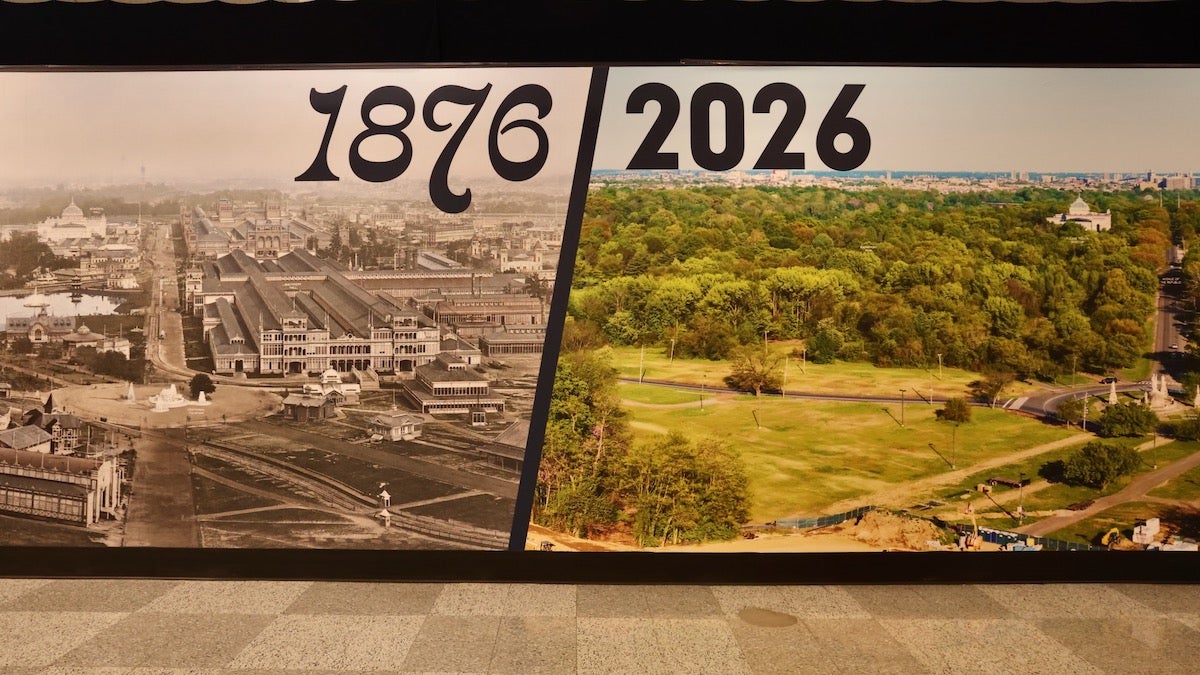
The 8,000-square-foot retail space is now being used during the nation’s semiquincentennial for “Revisit 1876,” a recreation of the 1876 Centennial Exposition in Fairmount Park.
“It was really America’s coming of age,” said Paul Levy, executive director of the Center City District Foundation. “It’s like a distant mirror for all the issues today. Philadelphia, today, was really built then, but all the issues we’re still wrestling with today, of inclusion and exclusion, were present in the whole situation in 1876.”
Paul R. Levy, executive director of the Center City District Foundation, stands in a representation of the Main Building at the 1876 World Fair at Fairmount Park. ”Revisit 1876,” a look back at the Centennial Exposition, opened in the former Ross Dress for Less space in the Lits Building and will be on view through December. (Emma Lee/WHYY)
The former discount clothing store has been set up with partitions representing four of the main buildings constructed for the expo: the Main Hall, Machinery Hall, Agricultural Hall and Memorial Hall, the only hall still standing now as the home of the Please Touch Museum.
Showcasing the might of Philly industry
The Centennial Expo was America’s first World’s Fair, a global movement spurred by England’s Prince Albert to showcase international culture and industry. As the so-called Workshop to the World, Philadelphia put its manufacturing muscle front and center.
Machinery Hall housed almost 13 acres of machines, all centrally propelled by a single, massive steam engine. The Corliss engine stood 45 feet tall and was connected to the network of machines by a milelong system of drive shafts and leather belts.
“This was the centerpiece of the fair,” Levy said. “America really impressed the 37 different nations and people who came here with our industrial prowess, our entrepreneurial energy. That Corliss steam engine was what everybody drew sketches of, took pictures of.”
A recreation of Machinery Hall showcases the Corliss Engine, a massive steam engine that powered nearly all the other machinery in the building. (Emma Lee/WHYY)
The flip side of making things is selling things, and the Centennial Expo promoted a culture of consumption. The exhibition features objects from the Drexel University’s Atwater Kent collection, the former Philadelphia History Museum archive, including souvenirs, puzzles and toys that were bought at the 1876 Expo.
“The fair was a huge shopping expedition. It was where you would go to get your swag,” said Rosaline Remer, a senior vice provost at Drexel University.
”Revisit 1876” includes artifacts from the Atwater Kent Collection of Drexel University, including Centennial souvenirs, games toys and puzzles. (Emma Lee/WHYY)
Remer loaned historic jigsaw puzzles, toy banks, wooden medallions and commemorative ribbons, all branded for the Expo.
“They’re all about being a visitor at the fair, being among millions who went and taking something home with you,” she said. “Something we’re all very familiar with today.”