

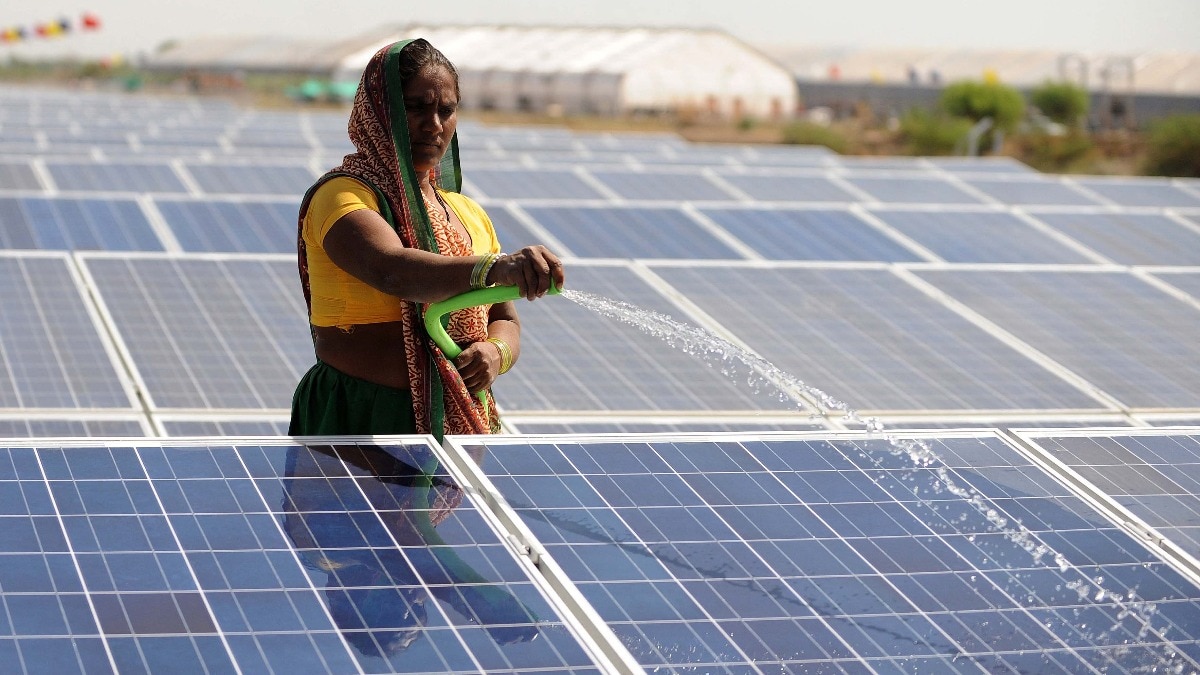
India is now generating so much solar electricity that it is increasingly being forced to throw part of it away. That’s because its storage capacity has failed to match steps with the generation capacity. Every day, enough clean power to supply more than a quarter of Delhi’s electricity demand is going down the drain because the country’s grid lacks sufficient battery storage and flexibility to save the afternoon’s solar surplus for the evening, when demand peaks.
The paradox is a consequence of India’s remarkable solar expansion. Solar power’s share of the country’s installed electricity capacity has risen from just 2% in 2015-16 to nearly 29% by May 2026, helping meet rapidly growing daytime electricity demand while reducing reliance on coal. But that success has exposed a new weakness in India’s energy transition.
As the world’s third-largest emitter of carbon dioxide and the fifth-largest economy, India has rapidly expanded renewable energy to reduce its dependence on fossil fuels. It is now producing clean electricity faster than it can store and use it.
The result is showing. On July 6, for a brief period, half of India’s power demand was met by renewable sources.
“India’s clean power just hit a new record. At 11:46 AM on 6 July 2026, more than half of India’s electricity came from clean energy sources, even as system demand hit 221 GW. Although a brief peak, this is a strong signal of where India’s grid is headed,” said Amitabh Kant, former Niti Aayog CEO, in a post on X on July 7.
However, India should now look at utilising all the power from renewable sources that it is tapping. For that, storage capacity expansion and grid management is required.
According to a working paper by the Economic Advisory Council to the Prime Minister (EAC-PM), authored by EAC-PM member Sanjeev Sanyal and IRS officer Satvik Dev, India routinely curtails enough solar electricity to power a major city — not because demand is lacking, but because there is nowhere to store the excess when it is generated. The paper argues that India’s electricity challenge has fundamentally shifted.
The question is no longer whether the country can generate enough power, but whether it can make solar electricity available when consumers actually need it.
Image Credit: Amitabh Kant/X
WHY THE TIMING MISMATCH OF SOLAR, COAL AND HYDRO POWER GENERATION IS COSTING INDIA
Based on the electricity data recorded every 15 minutes, the EAC-PM paper finds that India’s power grid is developing what is known as the “duck curve”. This means, during the day, abundant solar power meets much of the country’s electricity demand. But after sunset, when solar panels stop generating, demand remains high, forcing conventional power plants to quickly make up the shortfall.
During daylight hours, solar generation floods the grid. Since solar enjoys “first-run” or “must-run” status under India’s Electricity Rules, 2021, it is dispatched before coal and gas plants.
As solar output rises through the morning, conventional generators are forced to rapidly cut production. By late afternoon, however, solar generation begins disappearing precisely when household electricity demand begins rising. Coal, hydro and gas plants then have to step up to generate energy at extraordinary speed to meet the evening demand.
INDIA HAS MORE SOLAR ENERGY, STILL INCREASE IN CONVENTIONAL SOURCES OF POWER
The EAC-PM paper notes that this transition between solar, coal and hydropower has become dramatically steeper over the past three years.
Comparing average summer days in May 2023, 2025, and 2026, the morning ramp-down of conventional power generation through coal, oil, and natural gas almost tripled, from about 18 gigawatts (GW) in May 2023 to nearly 53 GW in May 2026, even as solar flooded the system.
One gigawatt equals one billion watts. One gigawatt of electricity is enough to power a crore (10 million) 100-watt bulbs.
The evening ramp-up almost doubled, climbing from around 36 GW (May 2023) to nearly 74 GW (May 2026). According to the paper, every passing year, conventional generators are being asked to swing faster between oversupply and shortage. This is happening despite India having more solar generation than ever before.
THE RISING SOLAR ENERGY, LACK OF STORAGE IS FORCING THE GRID TO WASTE ENERGY
The EAC-PM paper estimates that during May 2026 alone, India curtailed around 747 GWh of solar generation. On an average day, about 24 GWh of solar electricity had to be switched off or wasted, either because the grid could not absorb it or through ancillary market mechanisms designed to maintain system stability.
747 GWh (gigawatt-hours) is enough electricity to keep one crore (10 million) 100-watt bulbs glowing continuously for nearly 75 hours, or just over three days.
To put the figure in perspective, the authors note that Delhi consumes roughly 90 GWh of electricity daily. In other words, India is discarding enough solar electricity every day to power more than a quarter of the national capital, only to struggle with shortages a few hours later.
This contradiction becomes even sharper when the grid shortages are examined closely.
Across April and May 2026, India experienced electricity shortages during solar-hour peaks on only six out of 61 days. However, shortages during evening and nighttime peaks occurred on 36 of those 61 days, with deficits exceeding 5 GW on certain occasions.
The problem here isn’t inadequate power generation. It is the inability to shift abundant daytime solar electricity into evening hours when consumers actually need it.
ENERGY STORAGE HAS BECOME THE BIGGEST HURDLE FOR INDIA’S CLEAN ENERGY SHIFT
The EAC-PM paper argues that energy storage has become the missing link in India’s clean energy transition.
The authors of the paper estimate that flattening even half of a typical summer evening demand ramp would require around 130 GWh of stored electricity to be discharged between 1 pm and 8 pm. Yet India’s entire battery and pumped-storage fleet currently discharges only about 23.8 GWh on an average day.
While pumped-storage projects have almost achieved the capacity envisaged under the National Electricity Plan, battery deployment remains far behind target. Against a projected grid-scale battery capacity of 8.68 GW for 2026–27, only 0.27 GW had been installed by January 2026. Although recent additions have increased battery capacity to around 2.7 GW, the paper argues that the gap remains substantial.
According to a report by the Mumbai-based SolarQuarter, a solar energy media outlet, on May 4, around 47 lakh units of solar electricity were wasted at Rajasthan’s Bhadla Solar Park in just the first half of April. Between April 9 and April 15, power generation had to be reduced by 15% to 64% on several days because the grid could not handle the excess supply. This forced curtailment has led to notable financial losses for solar developers.
Speaking to Rajasthan Patrika, a Hindi newspaper, on the problem of solar energy storage, Minister of State for the Energy Department Heeralal Nagar said that, “Solar energy is Rajasthan’s strength. We are soon implementing a battery system, so that there shall be no need to stop energy production.”
“For storage, we have started setting up 6,000 MW batteries,” Nagar added while speaking to the newspaper.
Without rapid expansion of storage, India’s growing solar fleet could paradoxically worsen grid stress. Every additional solar panel deepens the midday surplus while doing little to address the evening demand surge. Conventional coal plants, meanwhile, are forced to repeatedly ramp down and ramp up, increasing operational costs, reducing efficiency, and accelerating wear on generating units.
INDIA’S NEXT CHALLENGE IS TO MAKE SOLAR ENERGY AVAILABLE ROUND THE CLOCK
The paper points to California as an example of how battery storage can reshape this challenge. There, large-scale batteries absorb excess solar electricity during the day and discharge it during evening peaks, reducing the burden on conventional generators and flattening the net load curve. The study argues that India will increasingly require similar capabilities as solar capacity continues to expand.
Recognising this shift, the government has already begun reshaping the regulatory framework. The draft Electricity (Amendment) Bill, 2025 and the draft Electricity (Rights of Consumers) Amendment Rules, 2026 seek to formally recognise energy storage systems within the power sector, deepen electricity markets, strengthen non-fossil purchase obligations, promote demand-response mechanisms and introduce mandatory time-of-day tariffs. Together, these measures aim to encourage storing cheap daytime electricity and using it when demand peaks after sunset.
India’s solar journey has often been measured in gigawatts installed. But the EAC-PM paper suggests that the next phase of the energy transition will not be determined merely by how much solar capacity the country adds. It will depend on whether the electricity generated by the afternoon sun can still be available after dark.
Until that happens, India’s solar revolution will remain incomplete. Millions of solar panels may continue to generate record amounts of clean electricity, but a growing share of it will be discarded because the country cannot yet save the afternoon’s sunshine for the evening hours when it is needed most.
– Ends
Published By:
Avinash Kateel
Published On:
Jul 13, 2026 07:00 IST