

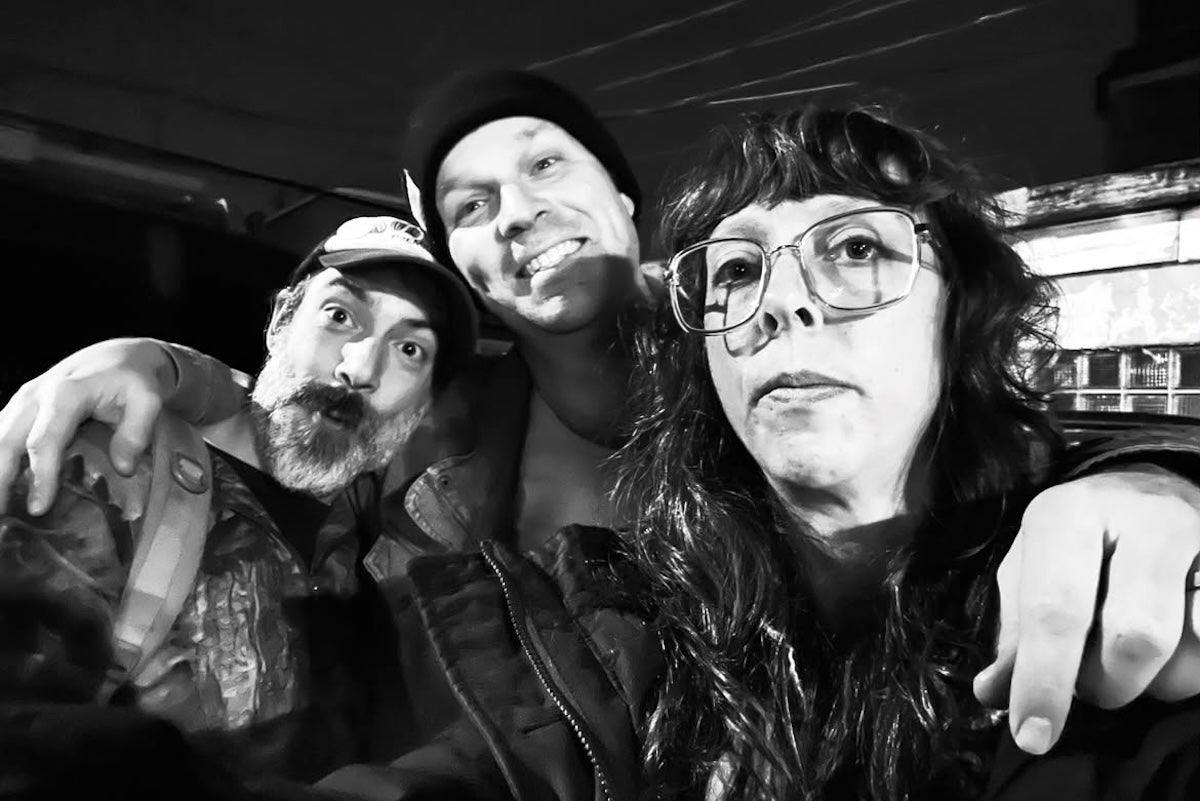
Bailey and Dustin began playing together in 1995, with Bailey on drums and Dustin on guitar. What started as middle-school jam sessions evolved through a succession of noisy punk and post-punk bands, forging a musical bond that would last decades.
Ashley, despite spending years around musicians, didn’t pick up an instrument herself until 2018, when she bought her first bass.
Yet, when the three finally played together, something clicked immediately.
“The first time I played the guitar with Ashley, and she played bass, it was a pretty big milestone in my life,” Dustin recalled. “We actually just started laughing out loud at each other.”
From that moment, Bailey said, the pieces seemed to fall into orbit.
“I think because we’ve known each other for so long, there was no feeling-out period. We didn’t need to figure out how it would work personality-wise,” he said.
Their shared obsession with music had become a shared language years before they ever formed a band.
“It’s almost like something that I feel like we gravitated toward without knowing,” Ashley said.
Heavenly Bodies performances can transition from mesmerizing to incendiary. (Courtesy of Heavenly Bodies)
Playing without a map
That familiarity allows the band to embrace uncertainty in ways many groups cannot. Instead of carefully mapped-out compositions, Heavenly Bodies developed a process built around trust, repetition and patient listening.
“We just made it a point to say, ‘Let’s play to all of our strengths and just play,’” Dustin said.
Much of the band’s music unfolds slowly and organically. Performances often begin with a simple pulse — a repeating bass figure, a guitar phrase or a drum pattern — before gradually expanding.
During the more ambient and spacey stretches, each musician finds ways to add small details, building layers around the others rather than competing for space.
Dustin often sways slightly, with his eyes closed, coaxing exploratory themes from his guitar. Bailey also often closes his eyes, while Ashley drops to her knees as the band settles deeper into its freeform sound.
Eventually, a steady bassline and drum beat emerge. The tune gathers momentum until Dustin drives it forward with waves of distorted feedback and heavy, flame-throwing riffs.
The effect of those moments can be cathartic, as what began as a heady pulse arrives 10 minutes later as an ecstatic wall of sound.